


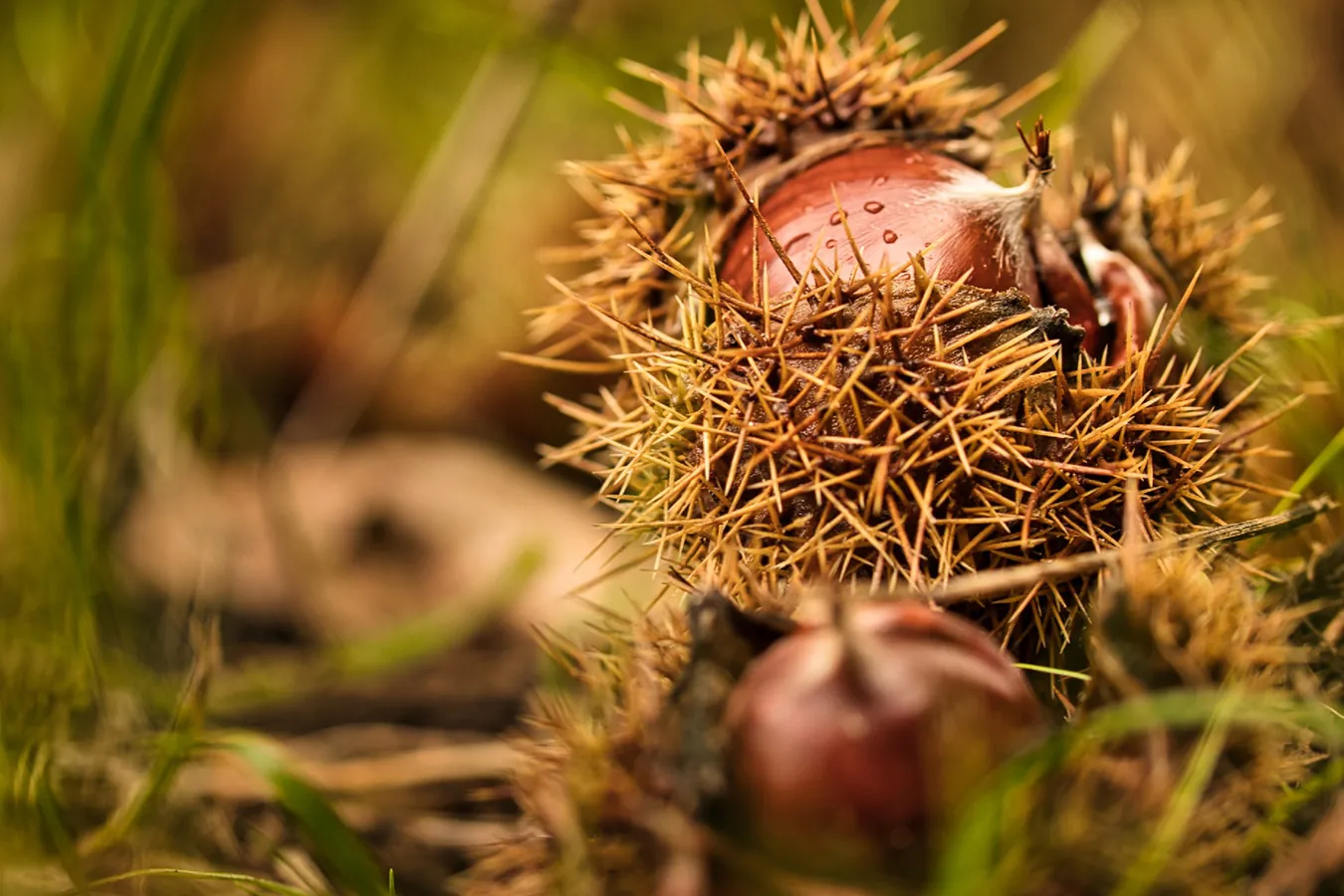
Harvesting Chestnuts
The chestnut harvest in Portugal normally runs from mid-October to early November, the exception being French hybrid chestnut trees, which ripen a little earlier, between late September and mid-October.
After harvesting, chestnuts have two main destinations: fresh consumption or processing.
Their use is increasingly diverse, from freezing to the manufacture of all sorts of food products, such as preserves, creams and purées, chestnut flour, sweets and jams, beer and liqueurs. It is therefore essential to take the greatest care when collecting, storing and dispatching the fruit, so that it reaches buyers in perfect condition and does not lose value after harvest.
Grove management and picking
The fruit normally falls of its own accord once it reaches maturity, a process that wind and rain can help along, or that can be forced by knocking the burrs down with poles. This last practice, however, should be used only exceptionally and with the greatest care, to prevent the chestnuts taking heavy knocks that would devalue them and make them more prone to rot.
During picking, it is advisable to separate the chestnuts by variety and size. Sorted this way, the product sold represents a significant addition to the income obtained.
In this crop, harvesting can be either manual or mechanical.
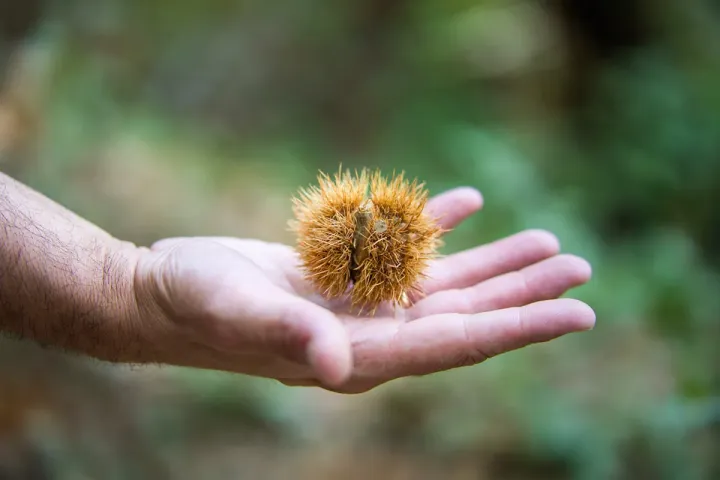
Chestnut burr
Manual harvesting
Manual harvesting calls for gloves so that the picker is not pricked by the burrs. Once picked, the chestnuts should be packed in mesh sacks to allow air to circulate and to prevent fermentation.
Manual harvesting is very costly, accounting on average for 50% of the running costs of a chestnut grove. Even so, it is still often preferred to mechanical harvesting when the fruit is destined for the fresh market, since the chestnut suffers none of the damage that can devalue the product.

Wearing gloves for the manual chestnut harvest
Mechanical harvesting
Mechanical harvesting of chestnuts is relatively recent, and came out of the adaptation of the machines used to harvest walnuts and hazelnuts, with some changes to allow the chestnuts to be separated from the burrs.
There are, however, still some problems: from the sheer size of the machines to the chestnut separation device, which is slightly abrasive and damages the fruit's epicarp (outer shell), dulling the shine and causing scratches and blemishes.
To mechanise this operation, groves must be large, flat and planted at a suitable spacing so that the equipment can move through them. The ground must be as clear as possible, free of loose stones and other objects. Mechanical harvesting is not viable if the grove is managed traditionally, that is, ploughed to control weeds. Those operations should be replaced by flail mowers that simply cut and shred the ground cover without affecting soil structure.
The mechanisation systems developed to date are based on suction harvesting from the ground. They are fitted with a centrifugal fan that produces the vacuum which lifts the fruit off the soil surface and carries it into devices that clean it and separate the chestnuts from the burrs. These machines may be large (self-propelled or towed behind a tractor) or small (adapted to be carried on an operator's back).
Equipment used in mechanical harvesting
Suction machines:
- Self-propelled or driven by a tractor, they work with a powerful suction system based on a flexible hose with one or two nozzles;
- This was the first system developed, and it works much like a domestic vacuum cleaner;
- An operator holds the end of the hose pointed at the ground, sucking up chestnuts, leaves and burrs, which are then separated inside the machine itself, which has a de-burring unit;
- On these machines the length of the suction hoses varies, and systems have been developed with hoses 25 m long, which gives a very wide working width;
- Output ranges from 150 to 400 kg/hour depending on the power of the machine; there is also equipment of this type with a suction hose only 5-8 m long, with an output of 100-120 kg/hour.
Self-propelled machines:
- They work in much the same way as the machines that sweep litter and leaves from city streets;
- They have a working front 1.5 to 3.5 m wide;
- Chestnuts, burrs, leaves, stones and other objects are drawn into a chamber where the heavier material is separated out and discarded;
- The rest passes through a tunnel with forced ventilation to remove leaves and other lighter impurities, and to separate the chestnuts from the burrs;
- A rotary screen then removes all remaining impurities of a different size from the chestnuts, which are carried into sacks or bins;
- Working output ranges from 500 to 1,600 kg/hour for the more powerful machines, and the minimum area needed to make this equipment pay is 10 ha;
- These machines can also harvest olives, hazelnuts and walnuts, provided the rotary screen is changed.
Portable pneumatic machines:
- Small in size, they can be an interesting option for small growers, given their low cost and high output, which quickly pays back the investment (they can replace the work of 3 people);
- A mechanical blower can be used to gather burrs and chestnuts together, which makes the pass easier and speeds up picking;
- Cleaning and de-burring the chestnuts can be done as a step after harvest, where harvesting takes place without simultaneous cleaning; there are machines on the market for this, as well as medium-sized static de-burring units;
- This option can be justified in groves planted on steep slopes.

Suction machine, self-propelled machine and portable pneumatic machine. Source: CIMO – Centro de Investigação da Montanha et al. (2019). Manual de Boas Práticas do Castanheiro. Instituto Politécnico de Bragança
Nets pulled by de-burring machines:
- These are normally used to complement manual picking, with nets laid on the ground beforehand to catch and gather the fruit;
- The nets are then pulled in, taking the burrs and chestnuts to the de-burring machine.

Nets pulled by a de-burring machine. Source: Laranjo, J. (2020). Colheita, Conservação, Comercialização e Boas Práticas. Curso de Cultura do Castanheiro (módulo 5). AgroB Business School EV.
Storage and preservation
Traditionally, the fruit is stored in a cool, airy place so that it does not lose too much weight and keeps its best characteristics until it is sold, which allows it to be held for 1 to 2 months. Piles of chestnuts should be no more than 25-30 cm deep. They should be turned daily, and can even be watered once a week if the place is too dry.
Cold stores (200 to 600 tonnes) can also be used, holding bins with a capacity of 400-600 kg of chestnuts at a temperature of 0-2 ºC and a relative humidity of 90-95%, which keeps them for around a month.
Another short-term preservation method (1 month at 18 ºC) consists of stacking the sacks on pallets, wrapping them in low-permeability plastic and then treating them with a massive dose of CO2 (45-50%).
Cold stores with a controlled atmosphere can now extend the storage period to 4-6 months, depending on the variety and on the weather conditions while the fruit was growing on the tree. These stores run at temperatures close to 0 ºC, with high CO2 and low O2 levels, preserving the fruit on the principle of slowing its metabolism.

Chestnuts for the fresh market
What methods do you use to harvest chestnuts?
Share your experience with us!
Keep exploring
The Galega, the Cobrançosa and the Verdeal: The Portuguese Native Varieties Conquering the World
At a time when olive oil is establishing itself as one of the most studied and most highly valued foods of the Mediterranean diet, Portugal is emerging as one of the leading players in the global market.
Climate change in Portuguese vineyards: what is changing and how to adapt?
In 2024, the International Organisation of Vine and Wine (OIV) recorded the lowest level of world production since 1961.

Frequently Asked Questions: Artificial Intelligence in Tourism Course
What is the aim of the AgroB Business School course on Artificial Intelligence in Tourism?