


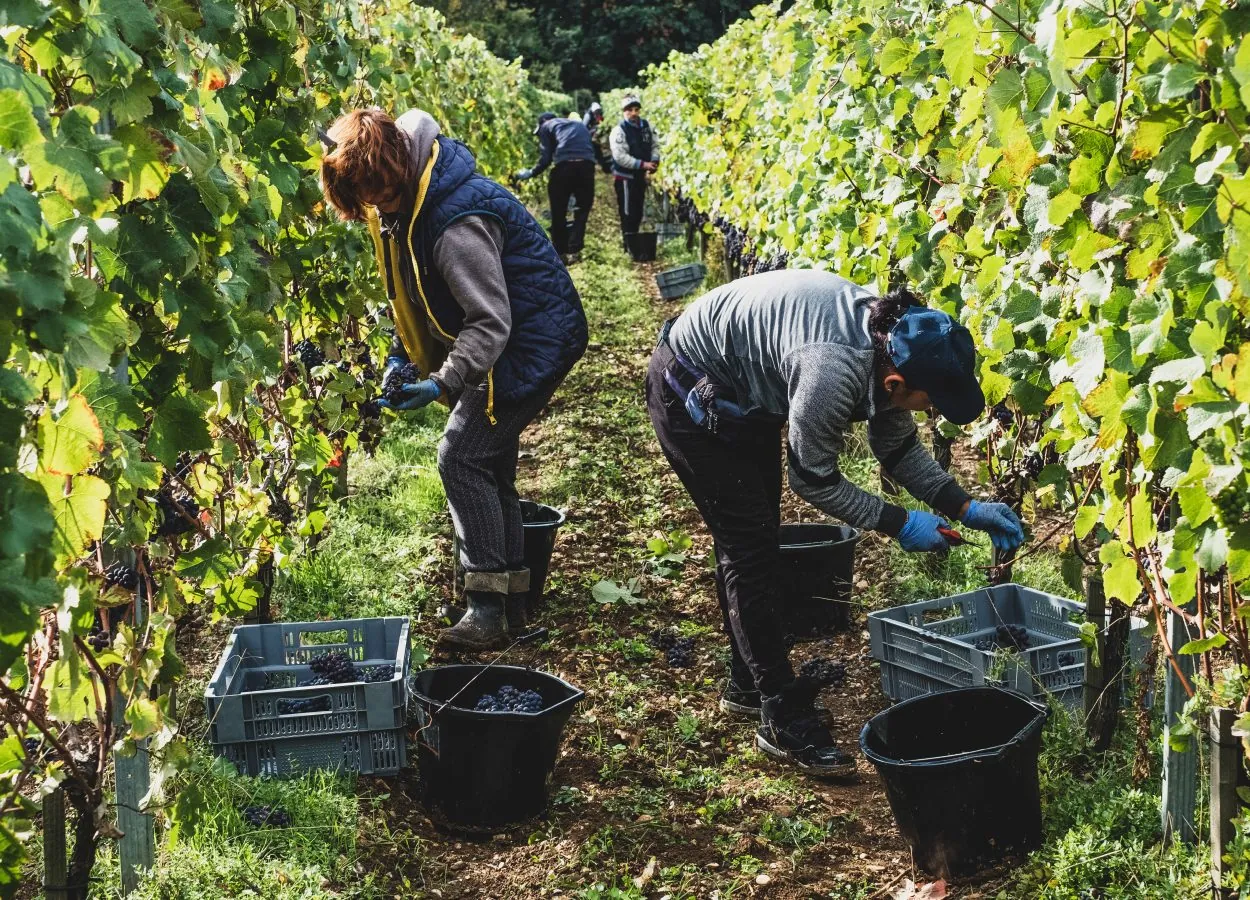
Climate change in Portuguese vineyards: what is changing and how to adapt?
In 2024, the International Organisation of Vine and Wine (OIV) recorded the lowest level of world production since 1961. The OIV's director general, John Barker, attributed this fall mainly to “extreme environmental conditions, heat, drought and unpredictable weather events” in producing regions in both hemispheres.
Europe, which accounts for 61% of world production, recorded 138.3 million hectolitres – the lowest figure since the start of the century. France fell 23.5% to 36.1 million hectolitres, the lowest level since 1957. Portugal followed this negative trend, with 6.9 million hectolitres and a fall of 8.2%.
What is really changing in the Portuguese vineyard?
- Harvests are happening earlier and earlier
Fifty years ago, October was harvest month in the Douro. Today, on many estates, picking starts in August. According to data gathered by growers and technicians over recent decades, the harvest date has moved forward by more than a month in several Portuguese regions.
According to Professor Carlos Lopes of the Instituto Superior de Agronomia (ISA), quoted in Agroportal, “Today harvests are done earlier and earlier, right at the beginning of August. The grapes ripen, they become sweet earlier, but there are other compounds that do not keep pace with that process.”
Grapes are ripening faster because of rising temperatures, which results in wines with higher sugar and alcohol levels. The practical outcome is grapes that are technically ripe but with an incomplete aromatic profile – the phenols and aromas do not follow sugar ripening at the same rate. Alcohol levels of 14% and 15% are increasingly common, above what international markets are asking for.
- Water stress is compromising entire cycles
When the temperature exceeds 35 ºC, the vine goes into defence mode and reduces or halts photosynthesis. This protective mechanism, which used to be triggered occasionally, has become routine in regions such as the Douro, where runs of 20 or more consecutive days above that threshold are now a reality.
Research produced under the WineClimAdapt project, coordinated by INIAV with an experimental site at Herdade do Esporão, studied the behaviour of around 190 grape varieties under water stress, using metrics such as water use efficiency (WUE) and thermography. The results show significant differences between varieties in their ability to withstand water deficit conditions – information that is decisive for anyone planning new plantings.
Carlos Lopes, Professor at ISA, stresses that choosing varieties is no longer just a question of oenological suitability: “Until now, we chose varieties according to their aptitudes; now we have to include other factors such as resistance to abiotic stress, temperature or water.”
- New pests and diseases are spreading
Scaphoideus titanus, the leafhopper that carries Flavescence dorée, is a clear example of the impact of climate change on pest dynamics. Native to North America and first detected in Portugal in 2000 in the north of the country, its range has expanded steadily.
In 2024, DGAV (Direção-Geral de Alimentação e Veterinária) published Order no. 39/G/2024, establishing four demarcated eradication zones for Flavescence dorée and updating the list of parishes where the vector insect is present. In 2025, a new demarcated zone was established in the municipality of Chaves. The trend is clear: milder winters favour the survival and expansion of the insect.
What is Flavescence dorée?
It is one of the most serious vine diseases, caused by a phytoplasma transmitted by the leafhopper Scaphoideus titanus. It blocks the phloem vessels, causes sugars to accumulate in the leaves, sharply reduces yield and progressively kills the vines within three years. It has been a quarantine organism in the EU since 1993, with a mandatory control plan in Portugal since 2013 (Ordinance 165/2013).
With all this evidence available, the main mistake growers make is to carry on working with the same parameters as 20 years ago: the same treatment calendars, the same irrigation timings, the same harvest decisions.
The increase in production volatility, which had fallen for decades thanks to improvements in technology and vineyard management, is back. Adapting is not optional. It is a question of medium term economic viability.
Adaptation is already happening on the most attentive estates and in the most attentive companies. There are four concrete lines of action with proven impact:
- Relocating vineyards to higher altitudes and north facing aspects. Companies such as Sogrape are developing experimental plots in higher areas of the Douro Superior to obtain fresher wines, in areas with greater diurnal temperature ranges. In the Alentejo, some producers are planting on the Alentejo coast, an area with no viticultural tradition, to obtain grapes with greater acidity and freshness thanks to the mild influence of the Atlantic, which they then blend with grapes from inland; other companies are choosing the Portalegre district for new vineyards because rainfall is more likely there in the future.
- Investing in varieties with greater resistance to water and heat stress. The WineClimAdapt project created rankings of sunburn tolerance and water use efficiency for around 190 varieties. Varieties such as Touriga Franca and Touriga Nacional have been studied by the Instituto Politécnico de Viseu in its 100 year projections for the Dão, pointing to the need for climate-smart approaches.
- Real time monitoring of soil water and evapotranspiration. Symington uses probes to measure water availability in the soil. Sogrape takes part in the European VitiGEOSS project, which uses satellite imagery to monitor plots. ADVID (Associação para o Desenvolvimento da Viticultura Duriense) leads the CoLAB VINES&WINES with a focus on water management in the Douro Demarcated Region.
- Precision irrigation, even in regions with a dryland tradition. Managing the vine's water relations is identified by ADVID as one of the priority tools for adapting to climate change, alongside modelling soil/plant/atmosphere relations. Grassing has also been adopted to protect the soil against erosion caused by intense rainfall over short periods.
Climate change is not a future threat to Portuguese viticulture – it is the reality of every campaign. The OIV's 2024 data is statistical confirmation of what growers have been feeling on the ground for years: earlier harvests, more intense water stress, new plant health pressures.
Portugal does, however, have unique advantages: a portfolio of around 300 native varieties, many of them historically adapted to heat and drought; an active scientific community in the main regions; and leading companies investing in research and technology. The question is not whether adaptation is possible – it is whether each producer will act in time.
There is no need to change everything at once. But ignoring the problem will cost more and more.
Sources:
OIV – State of the World Vine and Wine Sector in 2024, abril 2025. oiv.int
Voz do Campo – Adaptação da viticultura às alterações climáticas (Projeto WineClimAdapt / INIAV), janeiro 2025. vozdocampo.pt
Executive Digest – Alterações climáticas mudam perfil dos vinhos europeus (estudo PLOS Climate, Wolkovich et al.), maio 2025. executivedigest.sapo.pt
Agroportal – Vinho com menos cor e menor acidez: o impacto das alterações climáticas na vinha (Prof. Carlos Lopes, ISA), dezembro 2021. agroportal.pt
DGAV – Despacho n.º 39/G/2024 — Flavescência Dourada: zonas demarcadas em erradicação. dgav.pt
Agroportal – Flavescência Dourada da videira: nova zona demarcada (Despacho 72/G/2025, Chaves), julho 2025. agroportal.pt
Público / Fugas – O futuro do vinho em Portugal depende de uma revolução silenciosa, já em curso, novembro 2022. publico.pt
ADVID – Alterações Climáticas e Viticultura. advid.pt
Keep exploring
The Galega, the Cobrançosa and the Verdeal: The Portuguese Native Varieties Conquering the World
At a time when olive oil is establishing itself as one of the most studied and most highly valued foods of the Mediterranean diet, Portugal is emerging as one of the leading players in the global market.

Frequently Asked Questions: Artificial Intelligence in Tourism Course
What is the aim of the AgroB Business School course on Artificial Intelligence in Tourism?
Good practice for maintaining a healthy soil structure
Soil structure is one of the most critical factors in agricultural productivity.