


Fire blight: the threat putting the Rocha pear and the Alcobaça apple at risk
In the fertile fields of Portugal's Oeste region, the agricultural landscape is deeply marked by two fruits that have become national symbols: the Rocha pear and the Alcobaça apple. These crops represent decades of tradition and accumulated knowledge, they are the livelihood of thousands of farmers and they generate millions of euros in exports every year. But this success story now faces an unprecedented threat. The enemy is called fire blight, a disease that burns trees from the inside and that, in just a few years, has become the greatest danger to Portuguese fruit growing.
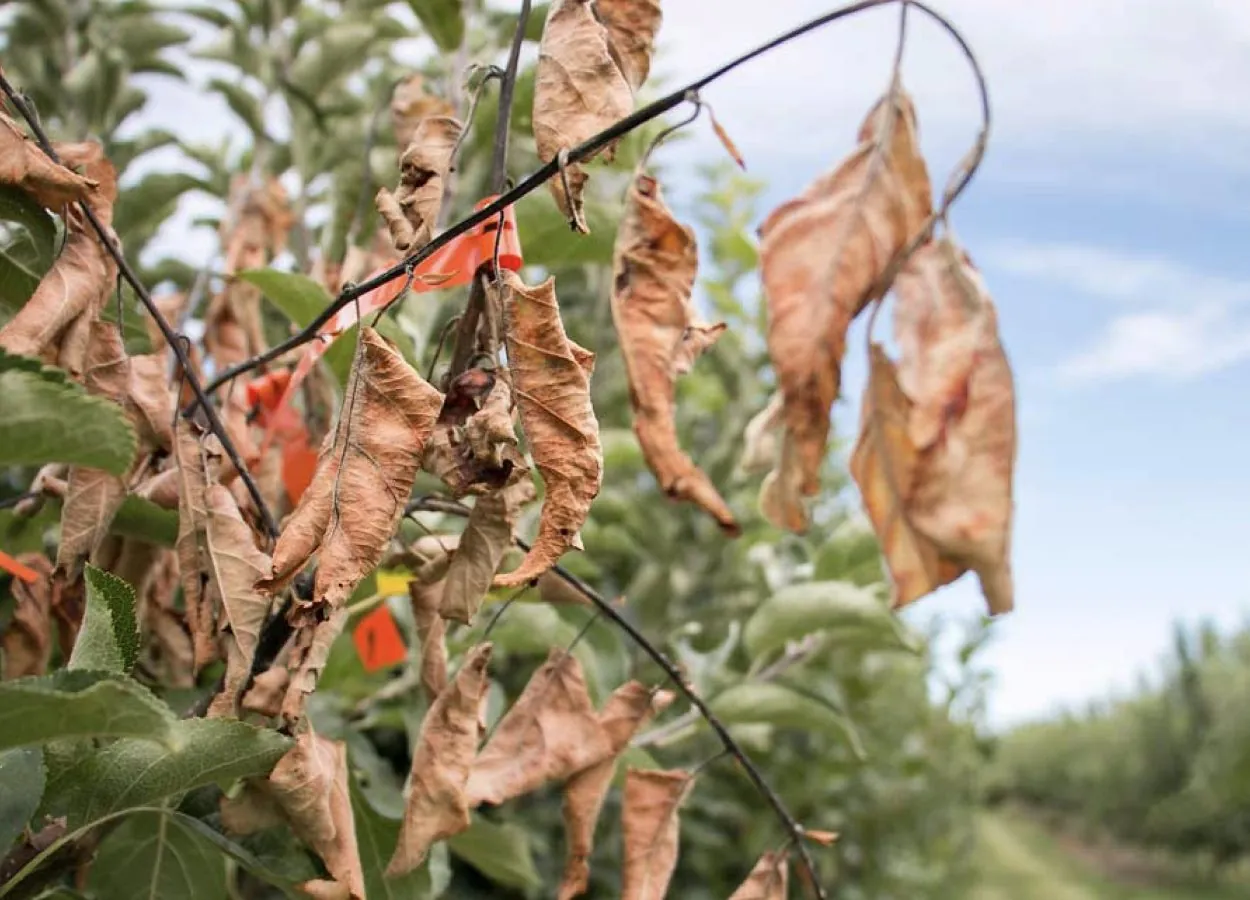
Fire blight is caused by the bacterium Erwinia amylovora, which attacks species in the rose family. Pear trees, apple trees, quince trees and hawthorns can all be infected. The symptoms are striking: branches and leaves that look scorched, blossom that wilts before its time, blackened, dried-out fruit often still clinging to the tree as if mummified. In severe cases, the whole tree eventually withers away.
The problem is not only the symptoms. The bacterium spreads easily on wind and rain, it is carried by pollinating insects and even by pruning tools or the clothes of anyone moving through the orchard. To make matters worse, unlike many diseases that lie dormant in winter, fire blight survives inside cankers on branches and trunks, returning in force when spring arrives. According to INIAV, this behaviour makes the disease all but endemic in regions such as the Oeste.
How the Erwinia amylovora cycle works
The cycle is continuous, and it explains why the disease is so hard to eradicate. Through the winter, the bacterium remains active in dark, cracked cankers on branches and trunks. With the arrival of spring, and temperatures between 15 and 25 degrees combined with humidity, the bacterium wakes up and begins to multiply, releasing a sticky exudate that oozes from the wounds. That liquid, whitish to amber in colour, contains millions of bacteria ready to travel.
The blossom, which appears at this time of year, becomes the main point of entry. Bees, flies and wasps carry the exudate as they visit the flowers, rain and wind spread the contaminated droplets, and even tools and clothing can carry the bacterium to new trees. Once established in the nectar, it multiplies rapidly and penetrates the internal tissues.
During the summer, the disease spreads to young shoots, leaves and fruit. It is at this stage that the symptoms become most obvious: new shoots curving into a shepherd's crook shape, scorched leaves and blackened fruit that stays attached to the trees. When its progress is not controlled, the bacterium reaches the trunk and the main branches, forming brown, cracked cankers. These cankers provide shelter through the winter, closing the cycle and ensuring that everything starts again the following spring.
Why is there no "cure"?
One of farmers' greatest frustrations is the absence of any effective treatment. Many ask why there are fungicides that control diseases such as downy mildew, but no bactericide to solve this problem. The answer is a harsh one: there is no cure for trees that are already infected.
The products available, such as copper-based ones, biological products or resistance inducers, only help to reduce the risk of infection before the bacterium gets in. But once it is established, there is no way of eliminating it. In the United States, streptomycin has been used in some regions since the 1950s, but in the European Union this use is banned on grounds of public health and bacterial resistance.
In Portugal, control depends on preventive measures and, in confirmed cases, on grubbing up and burning the infected trees. According to DGAV, in the guide published in August 2025, this remains the only effective solution in force.
There is hope in research, with projects studying the use of bacteriophages, seaweed extracts and breeding programmes to select more tolerant trees. These initiatives were highlighted by the Ministry of Agriculture in February 2025, in statements to Lusa, but they are still at an experimental stage and offer no immediate answer.
The Rocha pear: a national symbol at risk
The Rocha pear is a fruit unique in the world and holds Protected Geographical Indication status. Grown mainly in the Oeste, it accounts for more than 70% of Portugal's pear production, almost all of it destined for export to countries such as the United Kingdom, Brazil, France and Germany.
But the disease has already left deep scars. According to ANP, in statements to the Jornal de Notícias (24 August 2025), around 48% of the Rocha pear area was affected between 2021 and 2024, causing losses of 45 million euros. In 2023 and 2024 alone, 700 hectares of orchard disappeared, the equivalent of 35 million euros, according to ECO (1 February 2025). Production fell from 216,000 tonnes in 2021 to just 115,000 in 2024, again according to ANP speaking to ECO.
Beyond the direct loss of fruit, there are the costs of maintaining and clearing the orchards. Sanitary pruning, grubbing up and burning often cost tens of thousands of euros per holding, figures that are simply unaffordable for small and medium-sized producers.
The Alcobaça apple: a silent victim
If the Rocha pear is the most visible face of the crisis, the Alcobaça apple is also at risk. Holding Protected Designation of Origin status, it accounts for around half of Portugal's certified apple production and is grown in orchards spread across the municipality and the surrounding area.
Fire blight attacks apple trees just as readily. The blossom dries out, the branches take on a scorched appearance and the fruit blackens, staying attached to the tree. Some varieties show greater tolerance than the Rocha pear, but the bacterium does not discriminate. Outbreaks have already been recorded in Alcobaça, and growers are warning of partial losses. According to accounts gathered by the regional press in 2024, there is widespread fear that, if the disease continues to advance, apple trees will suffer the same devastation as the pear trees.
Stories that show the scale of the problem
The figures are striking, but farmers' stories make the crisis feel more real. Nelson Costa, a farmer from Caldas da Rainha, told the Jornal de Notícias (2025) that he spent 40,000 euros on clearance work in a single year and still lost more than half his crop.
In Bombarral, Vítor Fonseca, of Casa Agrícola da Gafa, told ECO (2025) that productivity fell from 35 to 17 tonnes per hectare in 2024. To protect his holding, he had to rent neighbouring land and grub up infected trees, since the owner did not have the means to act.
In Alcobaça, apple growers report symptoms in PDO apple trees, which heightens the risk of losing this national sector too.
Why the Oeste is a perfect target
The Oeste combines conditions that make the region highly vulnerable:
- The Rocha pear is genetically susceptible to fire blight.
- The agricultural landscape is dominated by large blocks of continuous monoculture, which makes it easier for the disease to spread.
- The Atlantic climate, humid throughout the year, favours the survival of the bacterium.
- Many orchards have pear and apple trees side by side, so there is always a host available.
- A single abandoned orchard or a neighbour without the means to intervene is enough to keep the disease active.
According to INIAV technicians (2024), this combination makes Portugal's Oeste one of the European regions most exposed to the spread of the disease.
Measures already under way
Despite the seriousness of the situation, efforts are being made to contain the disease. According to DGAV, in the guide published in August 2025, infected trees must be grubbed up and burned, tools must be disinfected and the movement of plant material without authorisation is prohibited.
Exceptional authorisation has been granted for the use of a bacteriophage-based product, PEA-02, seen as a hope for reducing disease pressure. This exceptional authorisation was announced by DGAV in 2025.
In parallel, the Comunidade Intermunicipal do Oeste has launched the campaign "Detetar cedo é travar a doença" (Detect early to stop the disease), reported in Voz do Campo (2025), to raise awareness among farmers and the general public.
On the political side, CONFAGRI called in February 2025, in a statement quoted by Vida Rural, for the situation to be recognised as a natural disaster. Meanwhile, the Ministry of Agriculture announced to Lusa, quoted by Notícias ao Minuto, that it is preparing a specific plan for the sector.
What still needs to be done?
Farmers acknowledge these efforts, but insist they are still not enough. Tackling the disease requires:
- Effective enforcement, to ensure everyone follows the rules.
- Financial support, without which many producers cannot bear the costs of grubbing up and replanting.
- More research, accelerating the development of biological solutions and resistant varieties.
- Collective planning, involving large and small producers as well as private gardens.
How have other countries dealt with the problem?
Fire blight is a global problem and has already left its mark in other countries. In Spain, according to the Spanish Ministry of Agriculture, severe outbreaks in pears and apples led to compulsory grubbing up and restrictions on the movement of plants.
In Italy, the Po Valley region suffered severe outbreaks in apple trees, forcing the rapid destruction of infected orchards, as reported in regional agricultural reports.
In the United States, according to Cornell University, the continued use of antibiotics since the 1950s has created resistant strains, which are now an additional problem.
In Morocco, the experience was devastating: the Rocha pear, which was once grown for export, all but disappeared after violent outbreaks. According to the Moroccan Farmers' Confederation, many growers abandoned their orchards.
What is at stake for Portugal?
The impact goes beyond individual holdings. According to ANP, the Rocha pear generates more than 85 million euros a year in exports. The Alcobaça apple is a prestige product with growing potential in international markets. Both sectors account for thousands of direct and indirect jobs.
Losing these crops would mean losing competitiveness, opening the door to imports and weakening the rural economy of the Oeste. Beyond the economic side, there is the cultural dimension: fairs, festivals and regional gastronomy revolve around these fruits, which are part of the country's farming identity.
Three paths could open up for the sector:
- Recovery: with financial support, effective measures and progress in research, it is possible to control the disease and restore production.
- Survival with losses: the disease becomes chronic, forces annual clearance work and generates recurring losses of 10 to 20%. The sector survives, but with tight margins and a dependence on subsidies.
- Decline: if nothing is done, more farmers abandon their orchards and Portugal goes from being an exporter to an importer of pears and apples.
Fire blight is more than a tree disease. It is a test of Portuguese agriculture's capacity for a collective response. The Rocha pear and the Alcobaça apple are not just fruits: they are national symbols, they create jobs, they sustain exports and they are part of our cultural identity.
As CONFAGRI warned in 2025, without recognition as a natural disaster and urgent measures, the sector could collapse.
Keep exploring
The Galega, the Cobrançosa and the Verdeal: The Portuguese Native Varieties Conquering the World
At a time when olive oil is establishing itself as one of the most studied and most highly valued foods of the Mediterranean diet, Portugal is emerging as one of the leading players in the global market.
Climate change in Portuguese vineyards: what is changing and how to adapt?
In 2024, the International Organisation of Vine and Wine (OIV) recorded the lowest level of world production since 1961.

Frequently Asked Questions: Artificial Intelligence in Tourism Course
What is the aim of the AgroB Business School course on Artificial Intelligence in Tourism?