


Promoting Farm Products on Social Media
Today, 77% of the Portuguese adult population is on social media, spending an average of 2 hours and 18 minutes a day there. The reasons for being there vary, but the following stand out (Datareportal, March 2025):
- 51% use it to fill their free time;
- 36% look for inspiration for future purchases;
- 35% consume informative or entertainment content, such as articles and videos;
- 26% turn to the platforms to search for specific products.
This behaviour shows the growing role of social media in the consumer journey and in shaping digital habits.
Which platforms have the greatest impact?
Before setting a content strategy, it is essential to understand which social networks offer your business the greatest reach potential. In Portugal, the three platforms with the widest adoption among adults are (Datareportal, March 2025):
-
WhatsApp — Used by 90% of the population, it shows a broad age distribution, with high usage across virtually every age bracket. There is only a slight decline among users over 65;
-
Facebook – Used by 71% of the population, it is strongest among users aged 25 to 54, who account for 62.6% of the total. Take-up among users under 25 is quite low, at just 7.9%. Those over 54 remain a relevant audience, though smaller than the 25 to 54 group, representing 29.4% of the total;
-
Instagram – With an adoption rate of 68% of the population, it stands out for the strong presence of users aged 18 to 44, who make up 67.6% of the total. From the age of 45 onwards, use of the platform shows a gradual downward trend, with only 6.3% of users aged 65 or over;
-
TikTok – With a usage rate of 42%, the platform is strongest among users aged 18 to 34, who represent 56.5% of the total. The remaining 43.5% are spread across the other age brackets, with take-up declining slightly as age increases.
Each of these platforms has distinct characteristics and calls for its own strategic approach, tailored to its audience and to the way that audience consumes information.
What type of content works best on each network?
To get the most out of a digital presence, it is essential to match content formats to the specifics of each network:
- WhatsApp is an extremely effective tool for communicating with customers and promoting farm products, especially when the goal is closeness, trust and direct selling.
- Facebook remains effective for sharing articles, events and informative content, and is also an excellent tool for interacting with local communities;
- Instagram stands out for its visual appeal. High-quality photographs, short videos, stories and reels are the formats that best capture attention;
- TikTok is the ideal space for creative, spontaneous and dynamic content. Its algorithmic nature allows for high organic reach, making it especially effective at capturing the attention of younger audiences.
Strategies for promoting farm products on social media
Farm products can be promoted effectively on social media even with limited resources, as long as the approach rests on three fundamental pillars: authenticity, consistency and closeness to the audience.
Now that the formats best suited to each social network are clear, it is time to define what type of content should be published to maximise engagement and the effectiveness of a digital presence.
Investing in authenticity and storytelling has become essential in today's social media landscape. Users tend to pay more attention to posts that tell real stories, share experiences or reveal what goes on behind the scenes day to day. This kind of content sparks curiosity, builds empathy and strengthens the bond between brand and audience.
Example: "It has been an intense week: we harvested what was left of the summer crop before the rain arrived. Everything is fresh and ready to make its way to you."
In the farming sector, storytelling plays a particularly important role. What is for sale is not just a product, but the reflection of a process, of accumulated know-how, of a deep connection with the land and of an ongoing commitment to quality. And all of that deserves to be shared.
While many brands compete for attention with aggressive promotional tactics, the producer who reveals the story behind their work stands out naturally. People do not connect only with products. They connect with people, with values and with a sense of purpose. That is exactly what storytelling delivers: it turns the ordinary into an experience with meaning.
Storytelling, in practice, means telling what happens before the product reaches the customer's hands. It means showing the rainy day that made harvesting harder, remembering the grandmother who taught you to make jam, explaining why you chose not to use chemicals on the soil, or sharing the joy of seeing the season's first blossom. It means humanising what you sell and making it unique. It is not about inventing stories, but about recognising the value of the journey and sharing it authentically.
Explaining how certain processes work, showing the path a project has taken or highlighting the stories of the people involved in the business are effective ways of generating engagement. Narrative content creates a context that goes beyond simply promoting products or services, making communication more human and more memorable. Publishing authentic, narrative-driven content consistently contributes not only to organic engagement, but also to building a solid brand identity on digital platforms.
The Vinho Verde producer Anselmo Mendes is an excellent example of managing social media effectively through storytelling, with posts featuring high-quality images and carefully composed framing. The brand makes the most of these platforms, going well beyond simply presenting the product. Through visual and written narratives, it conveys stories and shows the involvement and dedication behind every product, creating a richer and more engaging conversation with its audience.
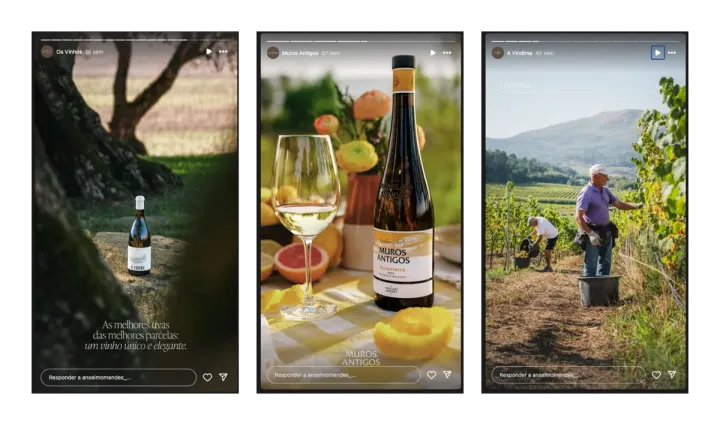
Figure: Stories from the Anselmo Mentes brand (Source: the brand's Instagram)
Prove is an example of how to communicate authentically the story and the faces of those who work the land and deliver fresh produce to consumers. The brand values and promotes the farmers in its network, telling people where to find them, and gives particular prominence to the quality of the products it sells. In doing so, it brings the public closer to where their food comes from and strengthens the link between producer and consumer.

Figure: Posts from the Prove brand (Source: the brand's Instagram)
Content production strategies
Short videos
Videos lasting 15 to 30 seconds are favoured by platforms such as Instagram and TikTok. These formats boost organic reach and require only a mobile phone and some creativity. Always pay close attention to, and give prominence to, whatever you want seen in the video, and avoid abrupt movements.
The first 2 seconds are decisive. Open with a striking image or a direct question.
Some effective examples include:
- The harvesting process in the field;
- Quick recipes using the farm's products;
- Genuine testimonials from consumers as they taste the product.
Captions with narrative content
The captions accompanying posts play an essential role. They should add context, emotion or information, giving the follower a deeper connection with the content. Descriptive messages such as "fresh carrots" can be replaced with explanations of how they are grown, the natural conditions involved and the values behind the production.
Example: "Our olive oil was bottled this week, cold-extracted and with very low acidity. Perfect for dressing salads and adding flavour to simple dishes."
Stories and highlights as engagement tools
The stories and highlights features allow for more dynamic and direct communication with followers. These formats should be used to:
- Reveal what goes on behind the scenes in production;
- Announce what is new;
- Answer frequently asked questions;
- Gather feedback through polls.
Using these tools regularly helps to increase engagement and the organic visibility of published content.
Local groups and communities on Facebook
Taking part in local groups and communities on Facebook is an opportunity to reach consumers interested in locally sourced products. These groups, usually tied to specific regions or towns, value domestic production and represent a direct channel to potential buyers.
Promotional messages via WhatsApp
WhatsApp has become an effective tool for promoting farm products directly, especially where the aim is to stay close to loyal customers. The trick is to vary the way you present the same product, avoiding sending the same message over and over. One effective approach is to explore different angles of communication, for example, with processed products, highlighting special launches, limited editions or end-of-stock offers.
Examples of effective messages
A honey producer, for instance, can announce the new harvest with a clear and appealing message: "Our summer wildflower honey is now available. It is 100% pure and extracted by hand, with a more intense floral flavour. Shall we set a jar aside for you?" This kind of communication keeps contact with the customer alive and prompts action naturally.
Sharing images
Visual content remains essential. Real photographs of the products, such as jars of honey, bottles of olive oil or dozens of fresh eggs, taken in natural light in simple, well-kept settings, are enough to convey authenticity and quality. Professional equipment is not necessary; a mobile phone and an eye for framing will do.
In short, promoting farm products on social media, whether through WhatsApp, Facebook, Instagram or TikTok, is now within reach of any producer. Large budgets and sophisticated equipment are not required. Most of the strategies set out here can be put in place with little or no investment, using nothing more than a smartphone and the willingness to show the work with authenticity and dedication.
By sharing the production process, the care taken in preparation, the stories behind the products and the impact they have on consumers' lives, you do more than make a sale. You build a genuine brand, close to its customers and with an identity of its own, and that is what sets a product apart in an increasingly competitive market.
With consistency, creativity and commitment, social media stops being just a communication channel and starts working as a natural extension of the farm business. It becomes a direct bridge to greater visibility, greater trust and stronger sales.
At Espaço Visual we help you promote your business in the best possible way! Find out about our Branding, Design and Digital Marketing service HERE
Keep exploring
The Galega, the Cobrançosa and the Verdeal: The Portuguese Native Varieties Conquering the World
At a time when olive oil is establishing itself as one of the most studied and most highly valued foods of the Mediterranean diet, Portugal is emerging as one of the leading players in the global market.
Climate change in Portuguese vineyards: what is changing and how to adapt?
In 2024, the International Organisation of Vine and Wine (OIV) recorded the lowest level of world production since 1961.

Frequently Asked Questions: Artificial Intelligence in Tourism Course
What is the aim of the AgroB Business School course on Artificial Intelligence in Tourism?