


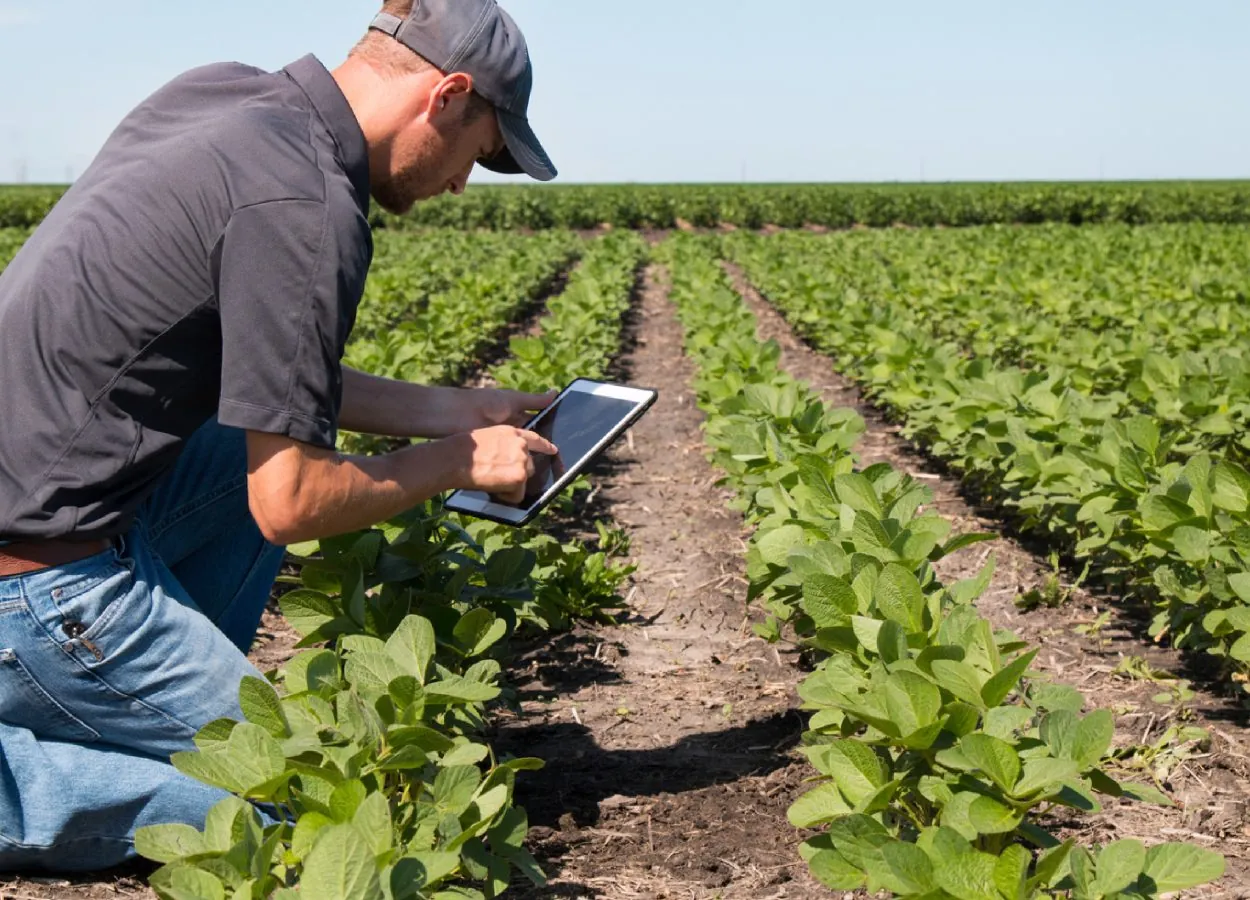
Digital Agriculture
Digital Agriculture: José Martino's opinion piece for Vida Económica
Digital agriculture has been one of the most talked-about topics in the farming sector in recent years. Drones, sensors, artificial intelligence, farm management platforms: there is no shortage of technology. According to the engineer José Martino, however, the problem in Portugal is not technological. It is structural, economic and political.
In an opinion piece published on 13 February in Vida Económica, José Martino argues that we continue to treat digital agriculture as a collection of interesting projects, when we should be seeing it as a structural economic tool for raising the productivity and competitiveness of Portuguese agriculture.
The author begins by clearing up a common confusion: digital agriculture is not the same thing as precision agriculture. Precision agriculture focuses on differentiated management of the plot, applying water, fertilisers or plant protection products in a way adjusted to the needs of each part of the field, in space and in time. Digital agriculture is a broader concept, bringing together continuous data, information systems, planning, risk management, sustainability and land governance. In other words, it is not only an agronomic tool but an economic and strategic one.
José Martino acknowledges that Portugal is not standing still. There are technically well-designed projects, above all in permanent crops, organised irrigation schemes, vineyards and olive groves. There are capable research centres, technology companies and innovative farmers. Adoption, however, remains uneven, fragmented and limited in scale. What is missing is turning innovation into functional systems that are accessible and economically viable for the majority of farms.
From an economic standpoint, the author frames digital agriculture as one of the few real levers for increasing the sector's efficiency. The agri-food complex accounts for around 5% of GDP and is crucial to exports, employment and territorial cohesion. Even so, average productivity remains below the European average and production costs are structurally high. Digitalisation therefore emerges as a way to produce more with less, manage water better, cut waste and mitigate climate risks, without relying exclusively on subsidies.
The policy framework has improved in recent years, with instruments such as the Innovation Agenda for Agriculture, PEPAC 2023-2027 and the PRR. Even so, well-known structural obstacles persist: weak links between industry and agriculture, investment costs that are high relative to the margins in the business, a deficit in digital skills, insufficient rural connectivity and technology systems that do not talk to each other. Until those blockages are resolved, digitalisation will remain confined to niches and pilot projects.
International comparison reinforces the point. According to José Martino, Spain has turned agricultural digitalisation into a structuring public policy, involving cooperatives, companies and public administration. Italy is moving quickly and pragmatically, embedding technology in the value chain. Portugal, despite its technical capacity, continues to fall short on coordination, governance and implementation models matched to the scale and to the economic gain for the farmer.
For the author, digital agriculture is not an end in itself but a means to improve incomes, reduce risks and make the sector more sustainable, above all in economic terms. The era of permanent pilot projects should already be over. What is missing now is political decision-making, a focus on delivery and the creation of real value for the farmer.
Without that, Portugal will go on postponing the structural modernisation of the sector and maintaining a large deficit in the agri-food trade balance.
Read the full article at www.grupovidaeconomica.pt
Keep exploring
The Galega, the Cobrançosa and the Verdeal: The Portuguese Native Varieties Conquering the World
At a time when olive oil is establishing itself as one of the most studied and most highly valued foods of the Mediterranean diet, Portugal is emerging as one of the leading players in the global market.
Climate change in Portuguese vineyards: what is changing and how to adapt?
In 2024, the International Organisation of Vine and Wine (OIV) recorded the lowest level of world production since 1961.

Frequently Asked Questions: Artificial Intelligence in Tourism Course
What is the aim of the AgroB Business School course on Artificial Intelligence in Tourism?