


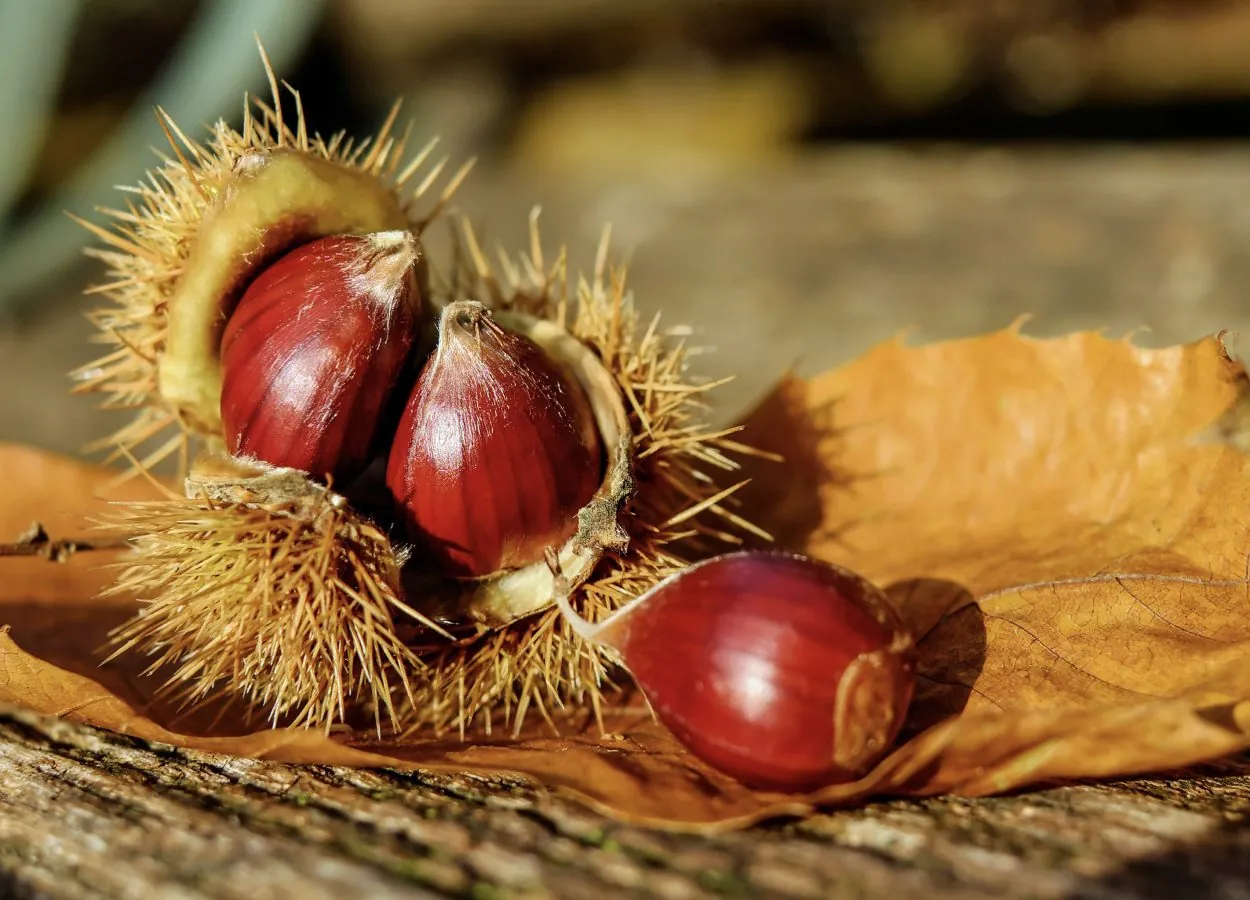
Chestnut Harvesting Best Practice: Raising Quality and Value in Challenging Times
The chestnut stands as one of Portugal's most emblematic agricultural products, carrying considerable economic, social and cultural weight, above all in the regions of Trás-os-Montes, Minho and Beira Interior. Its strategic relevance to the sector is beyond question, given the part it plays in creating rural employment, in export volumes and in the cultural identity of the producing regions. Growers, however, face a landscape of mounting challenges, from international competition to more demanding quality standards and the effects of climate change. Against this backdrop, reinforcing best practice at every stage of production is essential if standards of excellence are to be guaranteed and, in turn, the value and export capacity of the Portuguese chestnut increased.
The Foundation of Quality: Grove Maintenance and Nutrition
The quality, size and health of the fruit are determined long before harvest, during the maintenance and management of the crop. A shortage of nutrients, for instance, inevitably slows tree growth and has a direct bearing on yields. For this reason, the technical management of the soil is crucial.
Practices involving annual tillage should be strictly avoided, since studies indicate that they show no positive effect on productivity and, worse, contribute to the degradation of soil quality and of the sustainability of the system. The negative effects of tillage include reduced root size, loss of organic matter and destruction of mycorrhizae, as well as promoting the spread of ink disease (Phytophthora cinnamomi).
The most robust and sustainable technical option is soil covered with herbaceous vegetation, whether natural or sown. This cover brings a series of advantages, including improved water infiltration and soil aeration, and support for integrated protection systems through an increase in predator populations. When sowing a biodiverse permanent pasture, which should be a mixture of several species, the focus must fall on legumes (such as Trifolium subterraneum and Ornithopus sativus), since these fix atmospheric nitrogen, which in practice means the grower is able to reduce nitrogen fertiliser costs. It is essential that white lupin (Lupinus albus) is not used in this mixture, as it is a host of the dreaded ink disease. This pasture should be cut at the end of May or beginning of June and again before harvest, using flail mowers.

Fertilisation Guided by Technical Data
Fertilisation planning must be rigorous, grounded in soil analyses (recommended every three years) and in leaf analyses. Using these two management tools together avoids the excessive or insufficient application of soil improvers and fertilisers.
Soil correction should prioritise acidity and organic matter in winter. Since most grove soils in the producing regions are schistose or granitic in nature, with markedly high acidity levels (pH = 4 to 5), the application of dolomitic limestone is indispensable in raising the pH to the ideal range (5.5 to 6.5). As for nutrients, Potassium (K2O) and Phosphorus (P2O5) should be applied in winter. Phosphorus, particularly in the form of phosphonates, is vital to the tree's defence against ink disease, as it promotes the synthesis of phytoalexins (compounds with fungicidal action). For every tonne of chestnuts harvested (dry weight), an average of 10 kg of Potassium and 9 kg of Nitrogen are exported, figures that serve as the basis for replacement.
Nitrogen should be applied in May, and Boron is likewise fundamental in that period, being crucial to pollination and to protecting young trees against frost. A deficiency contributes to apical dieback and fruit abortion. In practice, this means that by correcting these deficiencies with small doses of boron (around 50 g of Borax per tree), the grower secures a significantly higher fruit set percentage.
Integrated Protection: Rational Control of Pests
From 2014 onwards, plant protection has been required to follow the principles of Integrated Pest Management (IPM), which resorts to chemical control only as a last resort, when it is acknowledged to be indispensable. Control is planned through risk assessment, which evaluates the intensity of the attack and the influence of environmental and cultural factors.
Monitoring, using visual observation along zig-zag routes across the plot and the use of traps (such as Delta-type pheromone traps), makes it possible to determine the Economic Threshold Level (ETL), which defines the exact moment when intervention becomes necessary.
In tackling the Chestnut Tortrix, which can lead to 220 kg of waste in every 1000 kg of chestnuts harvested, the technical approach is complex. Biological control involves the use of pheromones for the mating disruption technique (using 300 to 600 dispensers per hectare), which prevents mating. Recourse is also made to entomopathogenic microorganisms, such as Bacillus thuringiensis (CoStar WG®) and the fungus Beauveria bassiana (Naturalis®), which adheres to and penetrates the insects' cuticle. An advanced strategy is the autumn application of entomopathogenic nematodes (Steinernema feltiae) to the soil, where they seek out and kill overwintering larvae and pupae within 24 to 72 hours.
Against the Chestnut Gall Wasp (Dryocosmus kuriphilus), the only effective means of control is the biological control agent (Torymus sinensis). It is vital to know that part of the Torymus population may remain inside the dried galls for two years, so cultural practices must avoid cutting or burning this material after inoculation. In practice, adopting these strategies, together with sanitary control (such as Sanitary Pruning carried out in summer, in dry weather, to combat chestnut blight), is crucial.
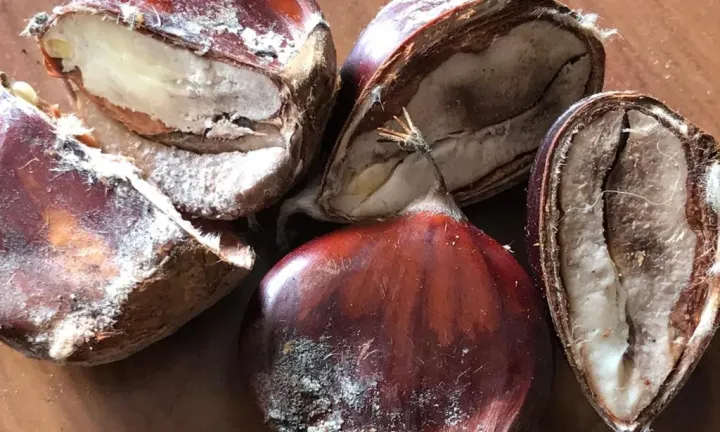
Chestnut Rot | Source: Renascença
IV. Rigour at Harvest and Advanced Post-Harvest Management
Harvesting typically takes place between the second half of October and the first half of November, depending on the variety and location. Manual harvesting, although costly (50% of grove maintenance costs), is often preferred for chestnuts destined for the fresh market, since it prevents the fruit from being scratched or knocked in ways that accelerate its deterioration.
In larger, level groves, mechanical harvesting by suction becomes cost-effective. For this, the soil must be as clean as possible, without traditional ploughing, the ground cover instead being cut with flail mowers. The work rate of these self-propelled machines ranges from 500 to 1600 kg/hour, with the minimum area needed to justify this equipment being 10 hectares.

Mechanised chestnut harvesting | Source: Contacto
High-Performance Storage and Marketing
Immediately after harvest, the crop should be packed in mesh or raffia sacks to aid aeration; plastic sacks are entirely inadvisable as they encourage fermentation. The rapid warming that results from the chestnuts' metabolism, intensified at ambient temperature, accelerates water loss and shrivelling, allowing fungi to take hold quickly.
For efficient storage, larger operations use cold rooms with temperatures between 0-2 ºC and relative humidity of 90-95%. For longer storage (4 to 6 months), controlled atmosphere (CA) is used, which works by slowing the fruit's metabolism through high CO2 levels and low O2 levels. Ensuring good ventilation in these chambers is essential to prevent condensation.
Control of the emerging rot (Gnomoniopsis castanea), whose symptoms are only visible when the fruit is cut open (the fungus can live as an endophyte with no external symptoms), is achieved in the warehouse through storage at 2 ºC and, as a treatment strategy, through the application of ozone. For the chestnut tortrix, industrial treatment involves hot water lines (45 minutes at 48 ºC) or cold water lines (5 to 8 days).
In marketing, grading is fundamental, since buyers pay more for homogeneous lots. The most common sizes vary, with the market requiring, for example, size 80/85 for roasters in Germany. Chestnuts must be classified in the Extra, I or II categories. For export, the demands are at their most exacting: companies are required to have their treatment facility certified with DGAV for countries outside the EU, guaranteeing compliance with phytosanitary standards. Traceability and labelling are crucial, and must show the variety name, the country of origin and the size.
For tourism operators, understanding this process is an asset, as it makes it possible to give visitors confidence in the quality and professionalism of the product, linking the experience to the landscape and to agricultural science.
V. Safety and Records (Technical Requirements)
Under Integrated Production, the field record book is a mandatory document. It must record, on a weekly basis, the occurrence of phenological stages, cultural operations, the incidence of crop pests and the application of Plant Protection Products (PPP) and fertilisers. The grower is required to attach proof of purchase of PPPs and fertilisers, along with the reports of the required analyses.
Good safety practice is fundamental when applying PPPs. The risk depends on toxicity and exposure, the aim being to reduce risk by reducing exposure. To that end, the operator must hold an Applicator Card and use appropriate PPE: a protective suit of at least Type 4 or 6, nitrile gloves and, when spraying, a mask with a filter rated at least brown (letter A2). While preparing the spray mixture, empty containers must be rinsed at least 3 times, adding the rinse water to the mixture, and application must never take place within 10 metres of watercourses.

Protective equipment during the chestnut harvest
In conclusion, the Portuguese chestnut, with its deep historical and economic significance, will only retain its competitiveness and value if the sector rigorously adopts these technical practices at every stage of production. Investment in advanced soil management, integrated protection, timely harvesting and storage under controlled atmosphere (CA) translates directly into reduced post-harvest losses, which in practice means more kilos of chestnuts sold at a good price. The ability to communicate this professionalism to the market and to tourism operators is the decisive factor that will secure the future and the excellence of this sector in the face of international competition.
Keep exploring
The Galega, the Cobrançosa and the Verdeal: The Portuguese Native Varieties Conquering the World
At a time when olive oil is establishing itself as one of the most studied and most highly valued foods of the Mediterranean diet, Portugal is emerging as one of the leading players in the global market.
Climate change in Portuguese vineyards: what is changing and how to adapt?
In 2024, the International Organisation of Vine and Wine (OIV) recorded the lowest level of world production since 1961.

Frequently Asked Questions: Artificial Intelligence in Tourism Course
What is the aim of the AgroB Business School course on Artificial Intelligence in Tourism?