


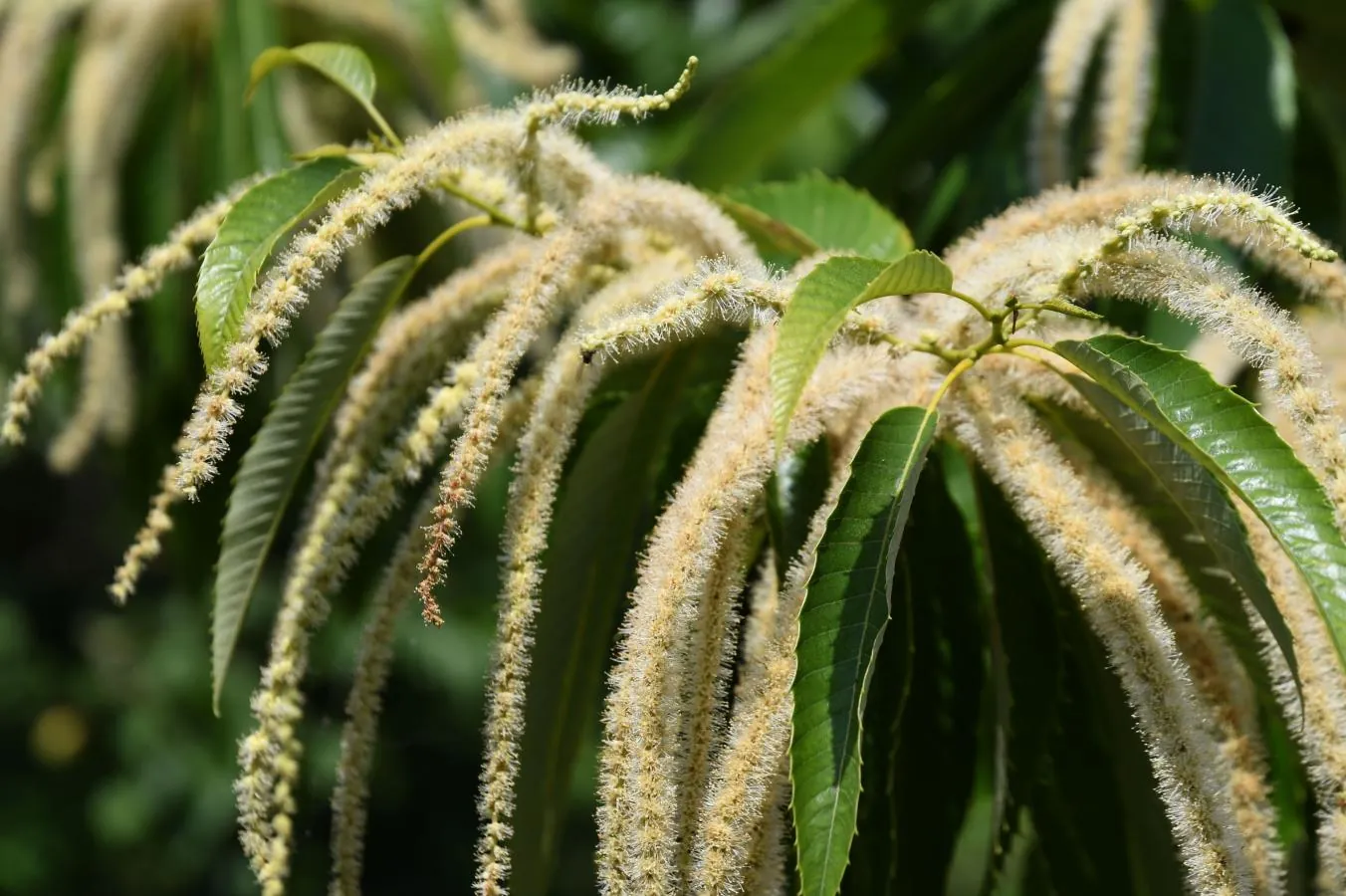
Flowering in the Chestnut Tree
The chestnut is a monoecious plant, that is, it carries both female and male flowers on the same tree. Flowering takes place on average between June and July, with the male flowers opening first.

Figure: biological cycle of the chestnut tree
The male flowers are catkins. They are grouped along a long, narrow structure and can reach 20 cm in length.
The female flowers appear at the base of some of the catkins, in groups of 2 or 3, inside a spiny structure that will become the burr.
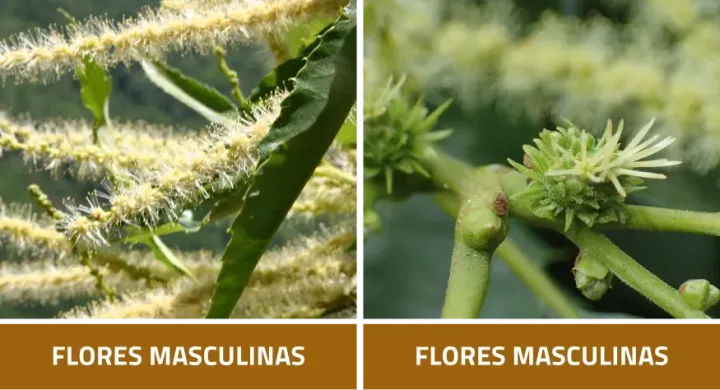
Over the years the plant has developed in such a way as to maintain entomophilous pollination, in other words pollination by insects, the best known of which are the honey bee, Apis mellifra, and the bumblebee, Bombus terrestris.
To attract and keep beneficial insects present all year round and so favour flowering, it is worth introducing companion flora along the margins or between the rows of the plot.

There are self-compatible chestnut varieties, in which entomophilous pollination coexists with anemophilous pollination. There are cases, however, such as Longal, that require pollinating varieties to be present in order to increase the genetic diversity of the grove.
The number of pollinators required differs according to the crop and the variety. Some basic conditions always apply, however:
- Maximum distance between a tree and a pollinator: 12-15 m;
- The corresponding number of trees per pollinator should not exceed 9;
- The flowering period must coincide.
Did you know these particularities of chestnut flowering?
Tell us in the comments.
Keep exploring
The Galega, the Cobrançosa and the Verdeal: The Portuguese Native Varieties Conquering the World
At a time when olive oil is establishing itself as one of the most studied and most highly valued foods of the Mediterranean diet, Portugal is emerging as one of the leading players in the global market.
Climate change in Portuguese vineyards: what is changing and how to adapt?
In 2024, the International Organisation of Vine and Wine (OIV) recorded the lowest level of world production since 1961.

Frequently Asked Questions: Artificial Intelligence in Tourism Course
What is the aim of the AgroB Business School course on Artificial Intelligence in Tourism?