


Cherry Growing in Portugal
Cherry growing (Prunus avium L.) plays a strategic role in Portuguese fruit production, with high commercial value and growing importance in the context of family farming and export.
In Portugal, cherry production is concentrated mainly in the Cova da Beira region, which includes the municipalities of Fundão, Covilhã and Belmonte. This region accounts for more than half of national cherry production.
Agronomic requirements of the crop
| Climate | Temperate with cold winters (>700 h <7ºC) Sensitive to late frosts and to rain during ripening (fruit cracking) Ideal: dry summers and stable springs |
| Soil | Loam to sandy loam Well drained (poorly drained soils cause root asphyxia and fungal problems such as Phytophthora spp.) pH between 6 and 7.5 Deep (>1 m) and rich in organic matter |
Cherry cultivars
Below we present some cherry cultivars and their characteristics:
Royal Tioga
- Medium to large size, 28 to 30 mm;
- Excellent firmness and high productivity, as well as high resistance to cracking;
- A very early variety. If all soil and climate conditions are met, harvesting can even take place in mid-April;
- Self-fertile: it does not need cherry trees of other varieties nearby for its flowers to be pollinated and set fruit;
- It needs only 350 chilling hours over the winter to complete its dormancy (number of hours at ambient temperatures up to 7ºC).
Nimba
- Large size, from 30 mm, but highly susceptible to cracking. If this cultivar is chosen, it becomes important to invest in installing tunnels on the plot;
- Relatively sweet, firm cherries;
- A very early variety, with fast and very high productivity;
- Self-sterile. Planting pollinating varieties is essential for this cultivar to produce.
Brooks
- Medium to large size, 28 mm;
- Relatively sweet, firm cherries. Very high productivity, but highly susceptible to cracking;
- Self-sterile. Planting pollinating varieties is essential for this cultivar to produce;
- Reasonably well adapted to cold regions. It needs approximately 520 chilling hours.
Pacific Red
- Large sizes, 28 to 30 mm;
- Cherries with excellent firmness and flavour. Considerable resistance to cracking;
- Self-fertile: it does not need cherry trees of other varieties nearby for its flowers to be pollinated and set fruit;
- Reasonably well adapted to cold regions. It needs approximately 520 chilling hours.

Figures: Royal Tioga (Source: Dalival), Nimba (Source: Cot International), Brooks (Source: Willis Orchard Co) and Pacific Red (Source: Cot International) varieties.
Sweet Lorenz
- Although it can be classified as an early cultivar, its harvest period is already close to mid-season;
- Large sizes, 30 mm;
- Cherries with excellent firmness and flavour, with high resistance to cracking;
- Very good productivity and a harvest period extending up to 15 days, which makes it easier to manage the labour required for the operation;
- Self-sterile. Planting pollinating varieties is essential for this cultivar to produce.
Frisco
- A cultivar that is also in the transition from early to mid-season.
- Medium to large size, 28 to 30 mm;
- Very sweet, firm cherries, but with medium resistance to cracking;
- Very good productivity and a harvest period extending up to 15 days, which makes it easier to manage the labour required for the operation.
Sweet Valina
- Very large size, 32 to 34 mm;
- Firm and very sweet cherries, but with poor resistance to cracking;
- Very good productivity;
- Self-sterile. Planting pollinating varieties is essential for this cultivar to produce.
Sunburst
- A cultivar with a harvest period in the transition between mid-season and the late season;
- Large sizes, 30 mm;
- Very sweet cherries, but with a somewhat soft texture;
- Considerable resistance to cracking and high productivity, as well as an extended harvest period of up to 15 days, which makes it easier to manage the labour required for the operation;
- Self-fertile: it does not need cherry trees of other varieties nearby for its flowers to be pollinated and set fruit.
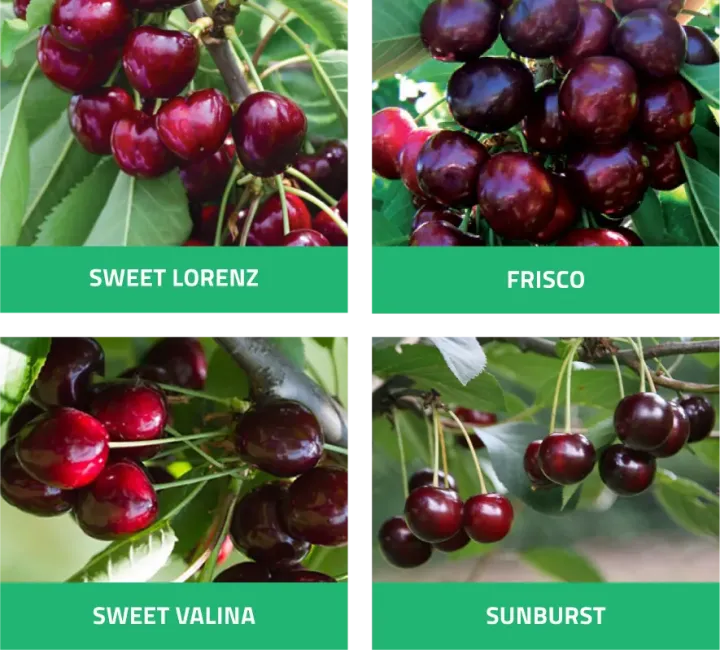
Figures: Sweet Lorenz (Source: A.N.A Chile), Frisco (Source: Cot International), Sweet Valina (Source: Dalival) and Sunburst (Source: RHS Plants) varieties.
Lapins
- Medium to large size, 28 mm;
- Moderately firm and sweet cherries, with considerable resistance to cracking;
- High productivity, but highly sensitive to brown rot – a disease with a major impact on cherry trees;
- Excellent adaptation to cold regions: it requires around 600 chilling hours over the winter;
- Self-fertile: it does not need cherry trees of other varieties nearby for its flowers to be pollinated and set fruit.
Sweetheart
- Medium size, 26 to 28 mm;
- Firm, moderately sweet cherries, with moderate resistance to cracking;
- A very late cultivar, but with high productivity;
- Excellent adaptation to cold regions: it requires around 650 chilling hours;
- Self-fertile: it does not need cherry trees of other varieties nearby for its flowers to be pollinated and set fruit.
Staccato
- Medium size, 26 to 28 mm;
- Firm, moderately sweet cherries, with moderate resistance to cracking;
- A very late cultivar, but with high productivity;
- Excellent adaptation to cold regions: it requires around 650 chilling hours;
- Self-fertile: it does not need cherry trees of other varieties nearby for its flowers to be pollinated and set fruit.

Figures: Lapins (Source: YOUGARDENER), Sweetheart (Source: Burchell Nursery, Inc.), Staccato (Source: Dalival).
Growers choose these varieties for their agronomic characteristics, such as disease resistance, productivity and fruit quality, as well as for their acceptance in the national and international markets.
Cultural operations for cherry
Pruning
- Training pruning in the first 3 years (modified vase, spindle)
- Annual fruiting pruning to renew the producing branches
Fertilisation
- Based on soil analysis**;**
- Importance of supplying boron, calcium and potassium**;**
- pH correction with agricultural lime, if necessary.
Plant protection
- Main pests: cherry fruit fly (Rhagoletis cerasi), aphids, birds**;**
- Main diseases: brown rot, shot hole, anthracnose**;**
- Integrated strategies (monitoring + targeted treatment).
Harvest and Post-Harvest
- Manual harvesting, with the stalk, into ventilated crates**;**
- Rapid chilling to preserve quality**;**
- For export, graded packaging and controlled storage.
Current challenges
- Climate variability: risk of cracking from rain during ripening
- Labour shortages at harvest
- The need for better organisation of production and export
- Sustainability: transition to integrated protection and precision agriculture
Cherry growing in Portugal is proving to be not only a well-established tradition but also a growing opportunity in the national and international fruit-farming landscape. Demand for high-quality fresh fruit, both at home and abroad, has been rising consistently, to the direct benefit of Portuguese growers.
Portuguese cherries stand out in particular in the markets of Central Europe, such as France, Germany and Switzerland, where they are prized for their flavour, freshness and superior organoleptic characteristics. This recognition stems not only from the excellence of the varieties grown, but also from the good agricultural practices adopted in the producing regions.
It is also worth highlighting the strategic advantage of staggered harvesting, made possible by the diversity of soil and climate conditions between Resende and Fundão. While Resende starts picking in April, offering the first cherries on the European market, Fundão extends the fruit's availability until July. This continuity of supply makes it possible to respond effectively to the demands of consumers and retailers, strengthening the competitiveness of Portuguese cherries in commercial and export channels.
Technical, structured investment in this crop, combined with territorial promotion and origin certification, therefore makes the cherry a true ambassador for Portuguese agriculture.
Keep exploring
The Galega, the Cobrançosa and the Verdeal: The Portuguese Native Varieties Conquering the World
At a time when olive oil is establishing itself as one of the most studied and most highly valued foods of the Mediterranean diet, Portugal is emerging as one of the leading players in the global market.
Climate change in Portuguese vineyards: what is changing and how to adapt?
In 2024, the International Organisation of Vine and Wine (OIV) recorded the lowest level of world production since 1961.

Frequently Asked Questions: Artificial Intelligence in Tourism Course
What is the aim of the AgroB Business School course on Artificial Intelligence in Tourism?